
Community Paediatrics is a specialist branch of children’s healthcare that supports the physical and emotional development, management of physical disabilities and safeguarding needs of children and young people. The team offer a range of services and assessments. Our specialist community paediatrics service assesses and cares for children and young people between the ages of 0 and 18. Our team also look after young people up to the age of 19 who are in special schools.
A community paediatrician may have an important role in initial diagnosis or assessing the impact of already identified conditions on a child’s development. Most often they work with young children under 5 years of age, but may also provide long term monitoring to identify and support any medical needs that arise over time for some groups of children and young people.
The Community paediatricians are one group of professionals who make up the Brent Child Development Service, alongside the Speech and Language Therapy Team, Occupational Therapy team and Physiotherapy Team. These teams may work separately or together to support children and young people, and also work closely with parents, health visitors, nurses, mental health services, social care and education professionals to help children achieve the best possible health outcomes.
The community paediatricians provide 8 key areas of service. These are:
· Child protection medical assessments
· Child Looked After initial health assessments (IHAs)
· Education and Health Care Plan Needs Assessment (EHC NA) service for children with physical health needs in particular
· General child developmental assessment service – this includes the initial assessment and medical follow up for children with a wide range of developmental conditions
· Autism assessments in children under 5 years old
· Assessments to confirm or refute Developmental Coordination Disorder at the request of the Occupational Therapy team
· Long term medical follow up for children with Down Syndrome and some other genetic conditions
· Long term medical follow up for children with complex physical disabilities
We look after children who have a wide range of health conditions. These might include children with:
- neurological conditions
- neuromuscular conditions (such as spinal muscular atrophy type 1)
- neuro-metaboloic and genetic conditions (such as Trisomy 13, or Trisomy 18)
- complex neurodisabilities
We look after children with physical disabilities, such as:
- cerebral palsy
- muscular dystrophy which has already been diagnosed
- spina bifida
We also look after children who have:
- genetic syndromes which require further health monitoring, such as Downs Syndrome
- complex neurodisabilities
- communications concerns, who need further assessment
We will also look after children over the age of five if they have complex developmental problems, such as movement disorders.
- Telephone: 020 8102 3456
- Email address: clcht.brentspa@nhs.net
- Location: 1st floor, Barham House, Wembley Centre for Health and Care, 116 Chaplin Road, Wembley, HA0 4UZ
We accept referrals for a child who has a postcode in Brent from:
- GPs
- health visitors
- specialist nurses
- therapists
- schools
- nurseries
- community paediatricians
- acute paediatric services
- social care.
Routine referrals will come through to the Brent SPA. The SPA will be available from 08:00 to 17:00. Outside of the SPA opening times, please use the SPA number and your call will be routed directly to the clinical teams that operate out of these hours. to contact the SPA, telephone 020 8102 3456 or email clcht.brentspa@nhs.net.
Only social workers or police can request a child protection medical assessment.
If you are not a social worker or police officer and have concerns about that a child or adult is at risk of, or experiencing, harm or abuse please either contact The Police on 999, or contact children’s social care in Brent at:
The Brent Family Front Door
Telephone: 020 8937 4300
Email: brent.lscb@brent.gov.uk
The CLCH website Safeguarding page has more information on general safeguarding advice in all the boroughs CLCH supports.
Who can be referred?
We accept referrals for:
- Children aged 2 years up to 18th birthday who live in Brent
- Children who require a child protection medical assessment for concerns regarding physical abuse, emotional abuse or neglect
We do not accept referrals for:
- Children who may have been sexually abuse, recently or in the past. Referrals should be directed via Police to local sexual assault referral centre
- HAVEN Tel: 020 3299 6900
- Referrals for possible female genital mutilation. Referrals should be redirected via Police to UCLH specialist clinic.
- Police to contact UCLH specialist clinic to arrange assessment at UCLH: Monthly Paediatric Clinic 0203 447 5241 or UCLH.PaediatricSafeguarding@nhs.net
- Children under age 2 years old: please contact the local hospital paediatric team (see referral information) as these children are very likely to require X-rays, blood tests or other investigations that are not available in the community setting.
- Adults aged 18 years or over, including those still in education or those with Learning Disabilities who may think and behave in a more child-like way. Please refer to adult social care.
How to make a referral for a child protection medical assessment (accordion)
The referral form can be downloaded here (please make this a link to the form, I’ll send that separately)
Referrals to be sent to safeguarding hub email clcht.centralhubsafeguardingchildren@nhs.net
Referrals are accepted between 9-5pm Monday to Friday (excluding bank holidays). Referrals outside of these hours should be sent to the local hospitals:
- LNWUH (Northwick Park Hospital) - 0208 869 2999 Email: LNWH-tr.safeguardingpaeds@nhs.net Out of office hours please contact the Paediatric Registrar on 0208 864 3232; bleep number 349 to discuss the referral further.
- Hillingdon Hospital - Please contact the on call Paediatric Consultant via the switchboard 01895 238282.
- Chelsea and Westminster Hospital - switchboard 020 3315 8000 then bleep number 0113.
- St Mary’s Hospital – switchboard 020 3312 6666 then bleep number 1202.
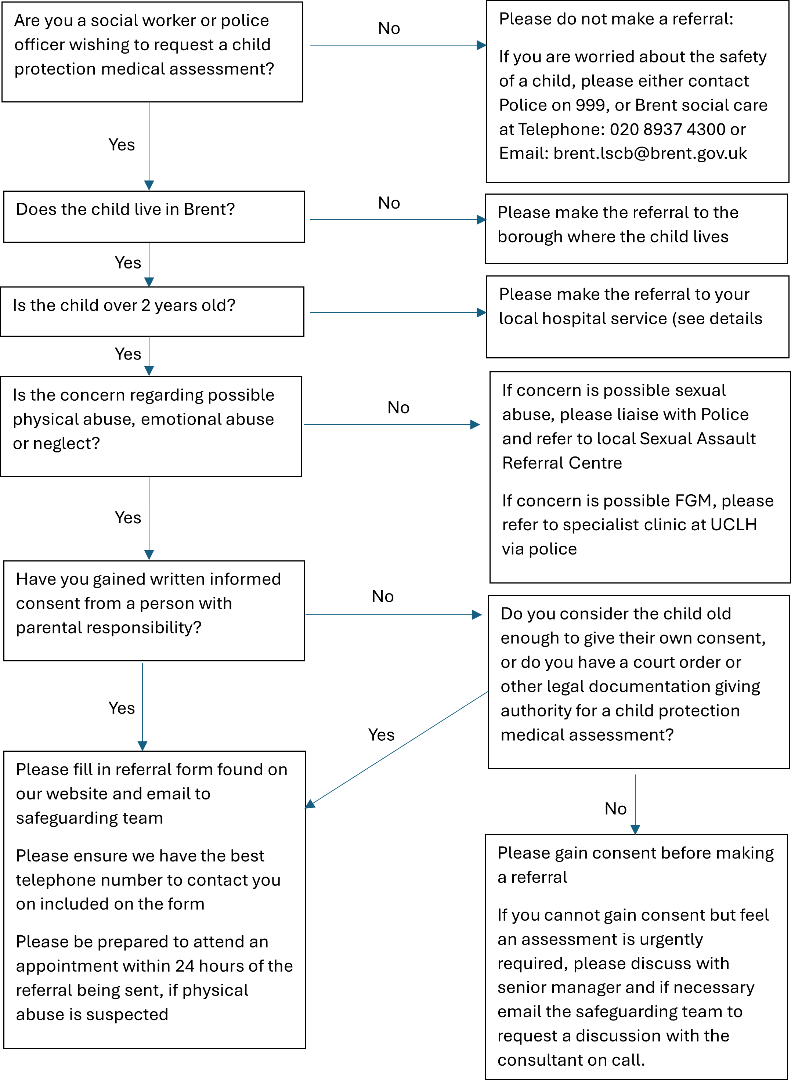
Informed consent is a key part of referring a child for a child protection medical. Consent is taken by social care prior to referral in most situations.
If informed consent cannot be obtained, a child protection medical assessment can still take place, if certain criteria are met. To discuss this, please make a referral, stating that consent could not be gained, the reasons why and the request to proceed without consent. The paediatricians will contact you to discuss the options.
Families, and older children, should be supported to understand what a chid protection medical assessment is, why it is being requested and what will be involved.
Please either give parents/carers/young person the leaflet for parents/carers on having a Child Protection Medical Assessment: this can be downloaded here (please make this the link to the leaflet which I will send you)
Or please direct parents / carers / young people to this website to see the FAQs detailed below.
FAQs: (accordion)
What is a child protection medical assessment (CPMA)?
A child protection medical assessment (CPMA) is a special doctor’s appointment. Social workers ask for it when they worry that a child might have been hurt or not cared for properly., so they ask the doctors for a check-up.
The doctor will see you in a private room, either at Wembley or Willesden Centre for Health. The doctor will ask questions and check the child or young person’s body. This is a chance to talk about any worries you or your child have about health, and also any worries that other people who know the child have shared.
Who do we see for child protection medical assessments in Brent?
We see children and young people who are between 2 and 17 years old and live in Brent.
We do not see children under 2 years old. They can still have child protection medical assessments, but these happen in hospitals.
We also do not see children or young people who might have been sexually abused. These kinds of checks are done by special teams in different places across London.
Who will be at the assessment?
Child protection medical assessments (CPMAs) are done by senior doctors who know a lot about children’s health and feelings. Usually, there are two doctors, or one doctor and another health worker to help.
Most of the time, a parent comes with the child or young person and stays during the assessment. But the child can also talk to the doctor alone if they want. Older children can ask for their parent to leave the room if they don’t want them there for the whole assessment.
If you or your child need an interpreter to help with language, social care will arrange one.
Sometimes, we might ask if a student doctor or student social worker can come and watch to learn. You can say yes or no to this—there is no pressure to have students there.
What happens at a child protection medical assessment?
The assessment has three parts.
Part 1:The doctors will ask questions about your child’s health, school, home, and family. They will ask you and your child (if they are old enough to answer). They will also ask about what happened that made social care ask for the assessment.
Part 2:The doctors will check your child’s body. They usually start with a full health check from head to toe. They will measure your child’s growth and look carefully at any marks or injuries on their skin. Any scars, marks, or injuries will be measured and drawn on a picture of the body. The doctor will write down how you or your child say they happened. You might be asked if it’s okay to take photos of important marks to keep in the medical record.
Part 3:The doctor will explain what they found and what they think about it. They will give advice about any health needs or what should happen next. You can ask questions, and the social worker there can ask too. The doctor will give the social worker a short note about their opinion. A detailed report will be sent within 2 weeks.
What should I tell my child about the assessment?
We know some children feel nervous about going to the doctor. You can tell your child that this visit is just like a regular doctor’s appointment and there’s nothing to be scared of.
The doctors have toys for younger children to play with.
It helps to explain that the doctor will ask some questions and check them to make sure they are healthy. The doctor will not hurt them or do anything that causes pain. Your child can also ask the doctor questions about their health or about what the doctor is doing.
Tell your child that they can choose who comes into the room with them.
Can I choose when the assessment takes place?
These health checks are urgent. Usually, the doctors will set up an appointment within 24 hours after they get the referral. So, no, you can’t pick the day or time or where the assessment takes place.
If I have more questions about this assessment, who can I ask?
The best person to ask is the social worker who asked for the assessment. If they don’t know the answer, they will ask the doctors for more information.